SWOT analysis is the most common strategy framework in business and one of the most commonly botched. Search "swot analysis" and you will find thousands of templates, most of them encouraging you to brainstorm vague bullet points in four quadrants for an hour. That is a whiteboard exercise, not strategy.
This guide covers what SWOT actually is, where it came from (not where most articles claim), how to do one that holds up under scrutiny, and the template you need to fill it out. The real company examples people search for, Tesla and Starbucks, are in here with current 2025 data, not recycled 2018 numbers.
The template is free and waiting at the bottom of the page. First, the framework.
What is a SWOT analysis?
A SWOT analysis is a strategic planning tool that organizes four categories of information about a business, project, or decision: Strengths, Weaknesses, Opportunities, and Threats. Strengths and Weaknesses are internal, things inside the organization that you can control, like capabilities, resources, culture, and financial health. Opportunities and Threats are external, market forces, competitive dynamics, regulatory changes, and economic conditions that happen to you whether you like it or not.
The internal versus external split is the part most people miss. A common mistake is listing "strong competitor" as a weakness. That is not a weakness. That is a threat. Getting the categorization wrong leads to strategies that try to "fix" problems that were never inside your control to fix.
Where SWOT actually came from
Most articles credit Albert Humphrey at the Stanford Research Institute for inventing SWOT in the 1960s. That is close to right but wrong on the details. The framework actually started as SOFT (Satisfactory, Opportunity, Fault, Threat) and was developed by a team led by Robert Franklin Stewart at Stanford Research Institute, presented at a Zurich seminar in 1964. Urick and Orr later swapped "Fault" for "Weakness," and the SWOT acronym stuck. Humphrey was part of the team and later popularized the framework, but the "Humphrey invented it" origin story is oversimplified.
Why does this matter? Because SWOT was designed for a 1960s strategic planning era when companies had stable markets and five-year plans. A lot of what feels limiting about SWOT today, its static snapshot quality, the tendency to list without prioritizing, comes from that inheritance. Knowing the origin helps you use the framework intentionally rather than religiously.
The four quadrants explained
Each quadrant answers a specific question about your business or project.
Strengths are internal advantages. What does your organization do well? What resources, capabilities, or positions do you have that competitors do not? Strong strengths are specific and measurable: "Customer retention rate of 72% vs industry average of 45%" is a strength. "Great customer service" is not.
Weaknesses are internal disadvantages. What do you do poorly? Where are you at a relative disadvantage to competitors or to what the market demands? Honest weaknesses are uncomfortable to write down, which is exactly why most SWOTs skip them. "Customer acquisition cost 3x higher than nearest competitor" is a weakness. "Need to improve marketing" is a to-do list item, not an analytical finding.
Opportunities are external conditions you could exploit. What trends, regulations, technology shifts, or market gaps could benefit your business if you moved on them? An opportunity is specific: "EU Digital Markets Act creates a 12 month window for new entrants in app distribution." A non-opportunity: "The market is growing."
Threats are external conditions that could hurt you. Who or what could damage your business regardless of what you do internally? Real threats include specific competitors, regulatory changes, technology disruption, or economic conditions. "Increasing competition" is not a threat. "New well-funded entrant with 2x our R&D budget launching Q3" is a threat.
What separates a good SWOT from a bad one
Most SWOTs fail the same way. They are a list of vague phrases that could apply to any company in any industry, generated in a one-hour meeting and filed away. A useful SWOT is specific, evidence-backed, and directly linked to strategic decisions.
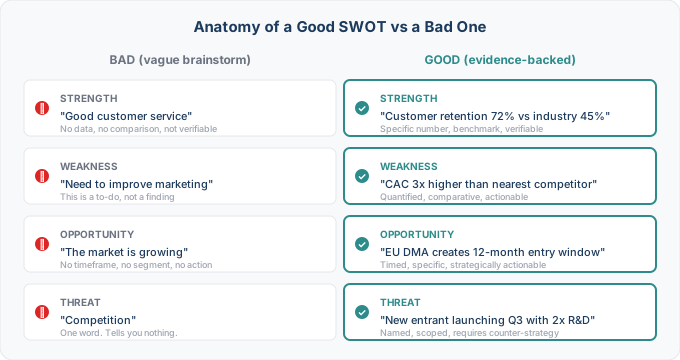
The difference is not intelligence or frameworks. It is the willingness to do the research to back each claim with a specific number, competitor comparison, or source. "Strong brand" without a metric is decoration. "Brand trust score of 68 vs industry average of 52 (2025 Edelman survey)" is an asset you can build strategy around. This is the kind of evidence that separates a one-hour brainstorm from the kind of SWOT analysis we build into every $497 Standard Dossier we deliver.
SWOT analysis examples from real companies
Generic examples are useless. Here are two real companies with current 2025 data.
Tesla SWOT analysis (2025)
Data sources: Tesla Q3 2025 earnings report, J.D. Power 2025 Automotive Loyalty Study, Tesla Supercharger network dashboard.
Strengths: Over 50% EV market share in the United States. Vertical integration from batteries through manufacturing. 65,800+ Supercharger connectors globally, a network competitors cannot replicate quickly. Model 3 customer loyalty rate of 72.1%, the highest in the automotive industry. Software and over-the-air update capability that traditional automakers still struggle with.
Weaknesses: Annual production capacity ceiling of approximately 900,000 vehicles creates delivery constraints. Premium pricing versus internal combustion competitors limits addressable market. Heavy key-person dependency on Elon Musk creates brand and execution risk. 4680 battery production yield issues have delayed next-generation vehicle launches. Aggressive price cuts in 2024 eroded gross margins to their lowest level in five years.
Opportunities: EV adoption still in early stages in emerging markets. Energy storage business (Megapack) growing faster than automotive. Robotaxi commercialization remains a potential category creator if regulatory approvals land. Grid-scale battery demand creates a second business line independent of car sales.
Threats: Chinese EV manufacturers (BYD, Li Auto, XPeng) reaching price and quality parity in key markets. Legacy automakers closing the EV gap with aggressive 2025-2027 product launches. US federal EV tax credit uncertainty under shifting administration priorities. Raw material price volatility on lithium and nickel. Brand polarization affecting US demand.
Starbucks SWOT analysis (2025)
Data sources: Starbucks FY2025 annual report, Starbucks Q4 2025 earnings call, company investor relations.
Strengths: 40,990 stores worldwide at end of FY2025. Rewards program with 34.6 million active US members and 75 million plus global members, functioning as both a payment platform and a behavioral data engine. Global brand recognition with pricing power most retailers cannot match. Vertically integrated supply chain for coffee sourcing.
Weaknesses: Negative US comparable store sales in 2024 and early 2025 signal core market fatigue. High employee turnover impacts service consistency and training costs. Menu complexity has slowed throughput, particularly at drive-through locations. Heavy reliance on US market for profitability despite international expansion.
Opportunities: New CEO Brian Niccol (arrived August 2024) leading turnaround with operational simplification. India and Southeast Asia growth markets. Cold beverage category still expanding. Mobile order-ahead operational improvements could recapture throughput.
Threats: McCafé and Dunkin' competing aggressively on price in the US. Third-wave specialty coffee brands eroding premium positioning. Climate change driving Arabica bean price volatility. Shifting consumer preferences toward local independent shops, particularly in younger demographics. Boycotts tied to geopolitical positions affecting Middle East and North American sales.
How to do a SWOT analysis
The mechanical process is simple. The research that makes it useful is not.
Step 1: Define the subject and decision. A SWOT for "our company" is too broad to be useful. A SWOT for "our decision to enter the European market in Q2 2026" is specific enough to generate actionable findings. Know what decision you are informing before you start.
Step 2: Gather evidence for each quadrant. This is where most SWOTs skip ahead. For strengths and weaknesses, you need internal data: financial metrics, customer retention rates, employee engagement scores, product quality benchmarks, competitive performance comparisons. For opportunities and threats, you need external research: market sizing, competitor analysis, regulatory monitoring, economic indicators.
Step 3: Write specific, evidence-backed statements. Every item should have a number, a source, or a competitor comparison attached. If you cannot source it, you do not know it yet.
Step 4: Prioritize. A 50-item SWOT is a to-do list, not an analysis. Cut it to the 3-5 most significant items per quadrant. What matters most for the decision at hand?
Step 5: Convert to strategy with a TOWS matrix. The biggest SWOT failure is stopping at the list. A TOWS matrix pairs your findings into four strategy types: SO (strengths used to capture opportunities), WO (weaknesses fixed to enable opportunities), ST (strengths used to defend against threats), WT (weaknesses addressed to avoid threats). This is how you get from analysis to action.
Turning SWOT into action with the TOWS matrix
The TOWS matrix is the upgrade most articles skip. It directly addresses SWOT's main weakness, which is that a list of factors does not tell you what to do. TOWS pairs each internal factor with each external factor to generate specific strategies.
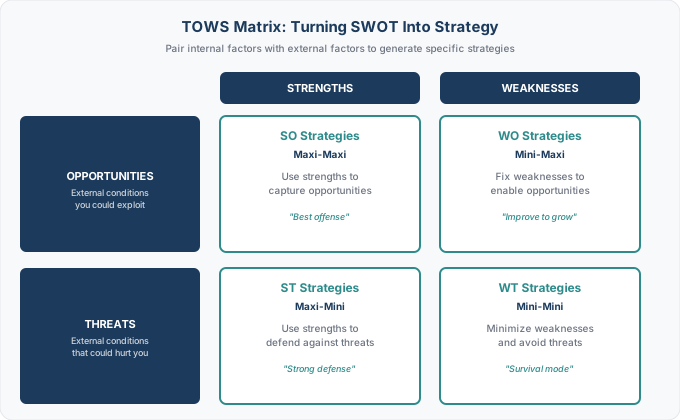
A TOWS pass takes 30 minutes once your SWOT is done and triples the practical value of the exercise. Most teams skip it because they are exhausted from the SWOT brainstorm. That is exactly why you should not run a SWOT as a brainstorm.
Worked example: Tesla TOWS strategies
Using the Tesla SWOT above, here is what a TOWS pass generates. Each strategy pairs a specific internal factor with a specific external factor.
SO Strategy (Supercharger network × EV adoption in emerging markets): Accelerate Supercharger buildout in high-growth non-US markets to lock in infrastructure advantage before Chinese competitors replicate it locally. This uses a core strength (65,800+ connector network) to capture an external opportunity (early-stage EV adoption outside the US).
WO Strategy (900K production ceiling × Megapack demand): Reallocate constrained manufacturing capacity toward higher-margin Megapack energy storage where demand outpaces supply. This addresses a weakness (capacity ceiling) to enable an opportunity (grid-scale storage growth).
ST Strategy (Model 3 loyalty × Chinese EV competitors): Double down on software and OTA update advantages to retain the 72.1% Model 3 loyalty rate as BYD and Li Auto reach price parity. Use a strength (loyalty + software moat) to defend against a threat (Chinese competition).
WT Strategy (Musk key-person risk × brand polarization): Establish a second operational leader with public visibility to reduce dependence on Musk and separate the brand from founder controversy. Minimize a weakness (key-person risk) to avoid a threat (brand polarization in US market).
Notice how each strategy is concrete enough to assign an owner and a deadline. That is the difference between analysis and action.
SWOT analysis for business vs personal use
The structure is identical. The data sources are different.
A business SWOT draws on market research, financial filings, customer data, competitive intelligence, and internal performance metrics. A personal SWOT draws on peer feedback, career assessments, skill evaluations, and market research on your target role or industry. Both benefit from outside perspective. People doing their own personal SWOT tend to overweight strengths and underweight weaknesses, which is why asking a trusted peer or mentor to review it is standard practice.
For a personal SWOT, frame it around a specific goal (a job search, a promotion push, a career pivot). A personal SWOT with no goal context produces generic reflections. A personal SWOT focused on "moving from senior engineer to engineering manager within 12 months" produces actionable priorities.
Common mistakes that make SWOT useless
The same failure patterns show up across published SWOT examples and the ones clients bring to strategy engagements.
The first is vague generic statements. "Strong brand" or "good customer service" are not findings. They are feelings. Every quadrant item needs to be specific enough that a reasonable person could verify it with data.
The second is confusing internal and external factors. Competitors are not weaknesses. Economic conditions are not strengths. If you can influence it, it is internal. If it happens to you, it is external.
The third is listing everything without prioritizing. A SWOT with 30 items per quadrant is unfiltered observation, not analysis. Cut to the 3-5 items per quadrant that actually matter for the decision you are informing.
The fourth is treating the SWOT as the deliverable. The SWOT is an input. The output is the strategic decision you make or the action items you generate. If your SWOT gets filed away after the meeting, you did brainstorming, not strategy.
The fifth is not updating it. Markets move. A SWOT from 12 months ago is probably wrong on half the external factors. Build a refresh cycle into any SWOT you rely on.
SWOT vs PESTLE vs Porter's Five Forces vs TOWS
SWOT is one of several strategic analysis frameworks. Each has a specific use case. Using the right combination produces better analysis than using SWOT in isolation.
| Framework | What it analyzes | When to use | Relation to SWOT |
|---|---|---|---|
| SWOT | Internal + external factors | Synthesizing findings before a decision | The hub; consumes output from the others |
| PESTLE | Macro-environmental forces (Political, Economic, Socio-cultural, Technological, Legal, Environmental) | Understanding external trends before entering a market or launching a product | Feeds the Opportunities and Threats quadrants |
| Porter's Five Forces | Industry structure: new entrants, buyer power, supplier power, substitutes, rivalry | Deep competitive analysis for industry strategy | Feeds the Threats quadrant and informs competitive Strengths/Weaknesses |
| TOWS Matrix | Paired internal and external factors | Converting SWOT findings into specific strategies | The required next step after SWOT, not an alternative |
The professional approach is: PESTLE and Porter's for external and competitive research, SWOT to synthesize findings with internal factors, then TOWS to convert to strategy. Most DIY SWOTs skip the first three steps and wonder why the output feels thin.
How long should a SWOT analysis take?
The honest answer: it depends on how much research you are doing.
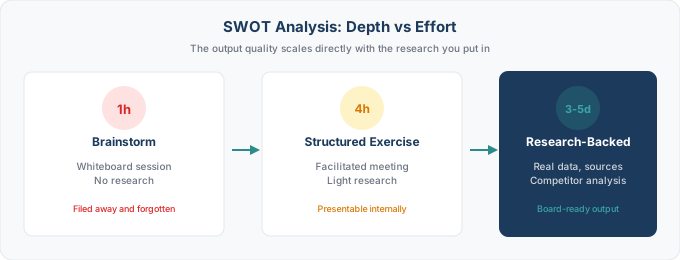
A 1-hour brainstorm produces a brainstorm. It is useful for getting a team aligned on gut-level perceptions, but it is not an analysis. A half-day exercise with a structured facilitator produces something you can present internally but will not hold up to external scrutiny. A research-backed SWOT with real data on competitors, markets, and internal benchmarks takes 3 to 5 days of focused work. That is the version that survives a board meeting or informs a real investment decision.
Most companies do the 1-hour version and call it strategy. That is why most SWOT analyses are filed away and forgotten. If you need the research-backed version but do not have a week to spend on it, that is the specific gap we fill with our Standard Dossier.
Download the SWOT Analysis Template
Here is the template. It includes the four-quadrant structure, guided questions for each section, and space to add evidence and sources for every item.
Free SWOT Analysis Template
PDF and Google Sheets format. Guided questions for each quadrant. Space for evidence and sources. Includes a TOWS matrix worksheet so you can convert findings into strategy.
- Four-quadrant SWOT worksheet
- Guided questions for each section
- TOWS matrix action worksheet
- Evidence and source tracking
Frequently asked questions
What should a SWOT analysis include?
A SWOT analysis should include specific, evidence-backed items in four categories: Strengths and Weaknesses (internal factors you control) and Opportunities and Threats (external factors that happen to you). Each item should have data, a source, or a competitor comparison attached. Limit to 3-5 items per quadrant to stay focused on what matters for the decision.
How long does a SWOT analysis take?
A brainstorming SWOT takes 1-2 hours. A meeting-based exercise with structured questions takes half a day. A research-backed analysis with real market data, competitive benchmarks, and internal metrics takes 3 to 5 days of focused work. The depth should match the importance of the decision you are informing.
What is the difference between SWOT and TOWS?
SWOT is a list of factors. TOWS is a matrix that pairs those factors to generate specific strategies. TOWS is not an alternative to SWOT, it is the required next step. A SWOT without a TOWS matrix is analysis without action. Most templates skip the TOWS step, which is why most SWOTs end up filed away.
Is SWOT still relevant in 2026?
Yes, when used correctly. SWOT remains useful as a structured way to synthesize internal and external findings into a strategic view. The problem is not the framework, it is the common practice of running SWOTs as one-hour brainstorms without research. A SWOT backed by PESTLE analysis, competitive intelligence, and real internal data is still one of the most effective strategy tools available.