Most competitor analysis templates you find online are worse than useless. They encourage you to list five competitors in a spreadsheet, tick boxes for features and pricing, and call it strategy. The resulting document tells you what you already knew and does nothing to inform a real decision.
This is a different kind of guide. We cover what competitor analysis actually is (distinct from competitive intelligence and competitive benchmarking, which most articles conflate), the six categories of data that matter, how to identify the competitors you are almost certainly missing, and real examples from Netflix versus Disney+ and Spotify versus Apple Music using 2025 data. The template is free and waits at the bottom of the page.
First, the framework.
What is competitor analysis?
Competitor analysis is a structured study of specific rivals, aimed at informing a particular decision. It is point in time, interpretive, and ends with recommendations. A competitor analysis produced for "should we enter the European market in Q2" looks very different from one produced for "how should we position against the new entrant our sales team is losing to."
Note what competitor analysis is not. It is not the same thing as competitive intelligence, which is the ongoing surveillance of direct, indirect, and potential competitors. CI is an inventory of the market. Competitor analysis is a focused report on specific players, built to inform a specific decision.
It is also not the same as competitive benchmarking, which is narrow and metric driven. Benchmarking asks "how do we compare to Competitor X on market share, NPS, and keyword rank?" Competitor analysis asks the broader question of "what is this competitor trying to do, how are they positioned to do it, and what should we do about it?"
Most templates blur these three disciplines together, which is why most competitor analyses feel thin. If you are running a real analysis, know which of the three you are doing.
The six categories of a useful competitor analysis
A competitor analysis that actually informs decisions covers six categories. Skipping any of them leaves a blind spot that can quietly undermine the entire exercise.
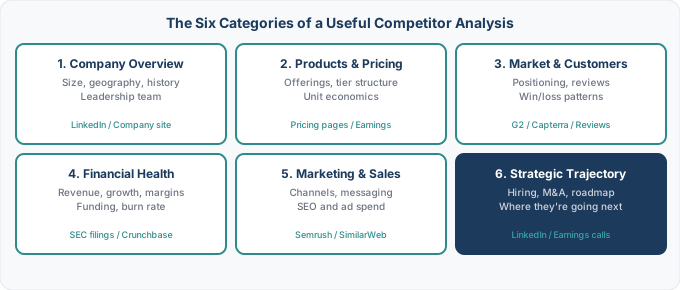
Company overview. Who they are, size, geography, history, leadership. This is table stakes, the cost of entry for the analysis, not the point of it.
Products and pricing. What they sell, how they price it, what their unit economics look like where you can see them. This is where most templates stop. It is where a useful analysis starts.
Market position and customers. How they are perceived in the market, who their customers are, win and loss patterns, customer satisfaction signals (reviews, NPS, retention rates where visible). A competitor that dominates on feature sheets can still be losing on customer sentiment. That gap is the opportunity.
Financial health. Revenue, growth trajectory, profitability, burn rate, funding situation. For public companies, SEC filings give you everything. For private ones, estimates from Crunchbase, PitchBook, and industry sources. A competitor with $200 million in revenue but burning $60 million a quarter is a very different competitor than one with $80 million in revenue and profitable.
Marketing and sales motion. How they acquire customers, what their messaging looks like, what channels they use, what their SEO and paid search strategy looks like, how they sell. This is the category where SimilarWeb, Semrush, G2, and LinkedIn hiring data earn their keep.
Strategic trajectory. Where are they going? Recent acquisitions, hiring patterns, product roadmap signals, executive departures, public statements. This is the category most analyses skip because it requires inference rather than data pulls. It is also the category that separates useful analysis from reporting.
Direct vs indirect vs replacement competitors
Most competitor analyses list the obvious direct competitors and call it done. That is how you get surprised by the adjacent entrant that eats your lunch while you were watching the wrong rival.
There are three types of competitors, and you need to account for all three.
Direct competitors sell the same product to the same customer solving the same problem. Coke and Pepsi. Netflix and Hulu. Asana and Monday. These are obvious and easy to identify.
Indirect competitors solve the same customer problem with a different product. A project management tool competes with Slack and Google Drive for team coordination workflows. A bike shop competes with a yoga studio for someone's fitness budget. These are the competitors your sales team knows about but your strategy team often does not.
Replacement competitors are any alternative use of the customer's time or budget. Reed Hastings famously said Netflix competes with sleep. He was not joking. A children's book replaces a mobile game for a free hour. Any product that occupies the same attention slot is, at the margin, a competitor.
The most dangerous competitors usually come from the adjacent category. They have a real customer base, they spot the opportunity in your market, and they add your feature set as a line item on an existing roadmap. By the time you treat them as a real competitor, they already have distribution you will spend years catching up on. A thorough competitor analysis monitors all three tiers, with the heaviest watch on adjacent players who could expand.
How to identify the competitors you are missing
The obvious competitors are the ones you already know about. The dangerous ones are the ones you do not. Here is how to find them.
Define competition by job to be done, not product category. If you sell competitive intelligence software, your competitors are not just other CI vendors. They are anything that helps a team act on market signals faster, which includes in-house analyst hires, general research platforms like Semrush, and even structured Notion templates that teams build themselves. The "we'll build it ourselves" answer is an indirect-but-real competitor that your pipeline tracker will never capture.
Watch for audience overlap. If your website visitors are also visiting a company you do not consider a competitor, your buyers already do. Tools like SimilarWeb show overlap between audiences. This is the earliest signal that a category boundary is blurring.
Turn your sales and customer success team into a sensor network. They hear unexpected company names in every call. The problem is that information dies in individual reps' heads unless you formalize a channel for it. A dedicated Slack channel for "unexpected competitor mentions" costs nothing and catches adjacent threats months before they show up in industry reports.
Check the "we used to use" list. Customer interview notes, G2 reviews, and churn exit surveys all contain references to what customers tried before you. That list is your real competitive set, not the one your marketing team imagined.
Competitor analysis examples from real companies
Generic examples are useless. Here are two current 2025 examples with real data. We are not taking a position on who wins, just showing what a data-backed comparison looks like.
Netflix vs Disney+ (streaming, 2025)
Data sources: Netflix Q3 2025 shareholder letter, Disney Q3 FY2025 earnings, The Wrap streaming industry tracker (November 2025), Hollywood Reporter analyst coverage.
Netflix strengths: 300 million plus global subscribers. 24 percent US streaming market share. Approximately $18 billion in 2025 content spend with a proven original content engine. Ad-supported tier reached 94 million monthly active users in May 2025, roughly double the prior year. Profitable at scale.
Netflix weaknesses: Slowing US subscriber growth as the market approaches saturation. Password-sharing crackdown produced a one-time boost that is now lapping. Content spend growing faster than ad revenue ramp. Live sports rights disadvantaged versus competitors with deep cable TV inheritances.
Disney+ strengths: 127.8 million Disney+ subscribers in Q3 2025, plus 55 million Hulu subscribers, for a combined streaming base of 183 million. Combined streaming profit hit $1.33 billion in fiscal year 2025, up from $143 million the year prior. Content library depth from Disney, Marvel, Pixar, Star Wars, and Hulu legacy content. Disney+ and Hulu app consolidation projected to save approximately $3 billion. Live sports exposure via ESPN inheritance that Netflix cannot match.
Disney+ weaknesses: Subscriber churn rate historically higher than Netflix. Reliance on tentpole theatrical releases for content pipeline. Heavier legacy TV business dragging on margins. Disney+ international growth has been slower than initial projections.
Strategic read: Netflix is the scale and profitability leader. Disney+ is closing the subscriber gap (analyst forecasts suggest Disney+ may surpass Netflix in subscriber count by 2026 at approximately 284 million projected) but is still catching up on margin. A new streaming entrant in 2026 has to decide which leader to position against, and the answer is different depending on whether the entrant is competing on content depth or unit economics. Most competitor analyses that treat Netflix and Disney+ as a single "streaming" category miss this distinction.
Spotify vs Apple Music (music streaming, 2025)
Data sources: Spotify Q2 2025 investor update, Apple Services quarterly results, Digital Music News market share tracker (August 2025).
Spotify strengths: 246 million plus premium subscribers globally. 600 million plus total users including free tier. Approximately 37 percent global market share. 53.8 million US subscribers with approximately 37 percent US share in May 2025. Year-over-year subscriber growth of 12 percent. Recommendation algorithm and discovery features consistently rated best in class. Podcast business provides a second growth lever independent of music economics.
Spotify weaknesses: Thin gross margins on music streaming due to label royalty structure. Dependent on Apple and Google for distribution on mobile, with ongoing fee disputes. Free tier cannibalization of premium conversion in price-sensitive markets.
Apple Music strengths: 94 million global subscribers. Approximately 32 percent US market share. Year-over-year growth of 6 percent. Bundled into Apple One subscription, driving attach rates. Deep integration with iOS ecosystem and Apple hardware. Lossless audio quality as a premium differentiator. Parent company financial strength allows content and exclusive deal spending unmatched by Spotify.
Apple Music weaknesses: Growth rate half of Spotify's. No free tier means slower top-of-funnel. Discovery and algorithmic curation weaker than Spotify's. Less transparent with subscriber and engagement metrics, suggesting softer underlying story than Apple would prefer to disclose.
Strategic read: The top three music streamers (Spotify, Apple, Amazon) hold 90 percent plus of US subscribers. New entrants into this market are not competing for share, they are competing for niches. The US paid music subscriber base crossed 100 million for the first time in 2025, meaning the pie is still growing, but category consolidation is largely complete. This is the kind of structural read that separates a useful competitor analysis from a feature comparison matrix. It is also exactly the depth we build into every $497 Standard Dossier we deliver.
Competitor analysis frameworks
SWOT is the framework people default to. It is also the framework CI practitioners increasingly dismiss as too shallow on its own. The frameworks below work better for competitor analysis specifically, though most situations benefit from combining at least two.
| Framework | What it analyzes | When to use | Limitations |
|---|---|---|---|
| Porter's Five Forces | Industry structure: new entrants, buyer power, supplier power, substitutes, rivalry | Entering a new market or evaluating industry attractiveness | Outside-in view only; ignores firm-specific advantages |
| VRIO | Firm-specific resources: Value, Rarity, Imitability, Organization | Evaluating whether a competitor's advantage is durable or copyable | Inside-out view only; needs industry context |
| Strategic Group Mapping | Clusters of competitors by shared strategic characteristics | Identifying white space and understanding positioning | Requires judgment on which dimensions matter |
| SWOT | Strengths, weaknesses, opportunities, threats | Synthesizing findings from the frameworks above | Too shallow on its own; list without prioritization. See our SWOT analysis template |
The professional approach pairs Porter's Five Forces (outside-in) with VRIO (inside-out), uses Strategic Group Mapping to visualize positioning, and uses SWOT as the final synthesis layer. Most DIY competitor analyses skip the first three and end up with a SWOT that has nothing underneath it.
Building a competitor matrix (the template)
The competitor matrix is the tactical piece of competitor analysis. It is a side by side comparison of competitors across the dimensions that matter for your specific decision. It is a useful tool, but only if you choose the right dimensions.
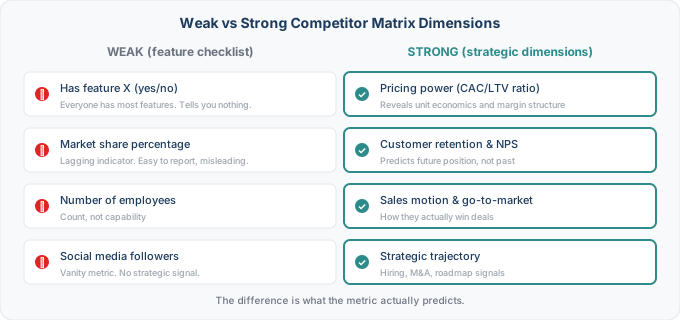
A weak competitor matrix compares feature checklists. Every competitor has most features. The matrix tells you nothing. A strong competitor matrix compares dimensions that actually drive outcomes: pricing power, customer retention rates, unit economics, sales motion, positioning clarity, strategic trajectory. The specific dimensions depend on the decision you are informing, which is why a good template starts with "define the decision" before "list the competitors."
Common mistakes that make competitor analysis useless
The same failure patterns show up in competitor analyses across industries and company stages. Here are the ones worth avoiding.
Paralysis by analysis. Teams compile exhaustive reports and produce no recommendations. A good competitor analysis ends with a decision or a prioritized list of actions, not a 40-page slide deck that gets filed away.
Drowning in data. Quantity is not quality. A five-page analysis of three competitors with clear strategic implications is more useful than a 30-page analysis of ten competitors with no conclusions.
Analyzing only direct competitors. Adjacent expanders are often the most dangerous threats. If your analysis only covers the obvious rivals, you are missing the ones that will surprise you.
Chasing surface-level metrics. Market share percentages, social media follower counts, and feature lists are easy to track, easy to report, and usually misleading. The signals that matter are retention, unit economics, sales motion, and strategic trajectory, and they are harder to find.
Neglecting the customer. A competitor can be crushing you on paper and still be losing to you in actual buying decisions. If you do not layer customer voice (reviews, interview notes, win/loss data) onto the analysis, you are analyzing a world that does not exist in the customer's head.
Treating it as a one-time exercise. A competitor analysis from six months ago is probably wrong on at least a third of the data points. Serious teams refresh at least quarterly.
Copying instead of differentiating. The point of analyzing competitors is not to match them. It is to find the gap you can own that they cannot or will not.
Where competitor analysis data actually comes from
Free sources cover more than most people expect. You do not need enterprise software to build a serious competitor analysis, though the paid tools accelerate the process.
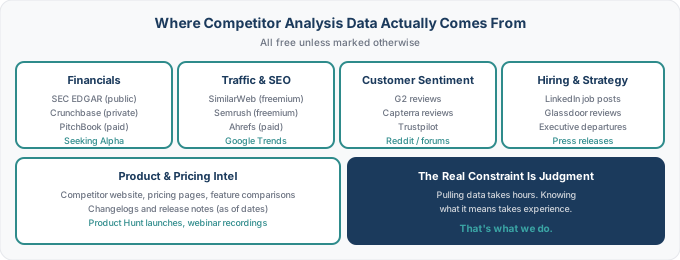
For financials, SEC filings (10-K and 10-Q) are the best source for public companies and cost nothing. Crunchbase covers funding history for private companies on a free tier. For traffic and SEO, SimilarWeb and Semrush both have usable free tiers. For customer sentiment, G2, Capterra, and Trustpilot are free. For hiring and org intelligence, LinkedIn is free. For earnings call transcripts and analyst coverage, seekingalpha.com and company investor relations pages are free.
The constraint is not access to data. It is time and judgment. Pulling the data takes hours. Knowing what it means takes experience. That is the specific gap we fill for teams that need the analysis done right but do not have a week to spend on it.
How long should a competitor analysis take?
Depends on how much rigor you need. A brainstorming session comparing three competitors on a whiteboard takes an hour. A structured comparison across five competitors using the six-category framework takes a full day. A research-backed competitor analysis with current financials, customer sentiment data, strategic trajectory inference, and actionable recommendations takes three to five days of focused work. That is the version that actually informs a real strategic decision.
Most companies do the one-hour version and wonder why their strategy is not working. The answer is usually that the analysis was never thorough enough to inform the strategy in the first place.
Download the Competitor Analysis Template
The template covers all six data categories, includes a direct/indirect/replacement competitor worksheet, a competitor matrix with strategic dimensions (not just features), and space to attach evidence and sources to every claim.
Free Competitor Analysis Template
PDF and Google Sheets format. Six category framework, direct/indirect/replacement worksheet, strategic competitor matrix, and evidence tracking.
- Six-category analysis framework
- Direct/indirect/replacement worksheet
- Strategic competitor matrix
- Evidence and source tracking
Frequently asked questions
What should a competitor analysis include?
A useful competitor analysis covers six categories: company overview, products and pricing, market position and customer sentiment, financial health, marketing and sales motion, and strategic trajectory. Each should be backed by specific data and sources, not assertions. Skip any category and you leave a blind spot that can undermine the entire analysis.
How long does a competitor analysis take?
A quick brainstorm comparing three competitors takes about an hour. A structured six-category analysis of five competitors with free data sources takes a full day. A research-backed analysis with current financials, customer sentiment, and strategic trajectory takes three to five days. Depth should match the importance of the decision you are informing.
What is the difference between direct and indirect competitors?
Direct competitors sell the same product to the same customer solving the same problem (Netflix and Hulu). Indirect competitors solve the same customer problem with a different product (a project management tool competing with Slack for team coordination). Both matter. The dangerous competitors are often indirect ones expanding into your category.
What tools do I need for competitor analysis?
You can run a serious competitor analysis using only free tools: SEC filings for public company financials, Crunchbase for private company data, SimilarWeb for traffic, G2 or Capterra for customer sentiment, LinkedIn for hiring and org data. Paid tools like Semrush, SimilarWeb Pro, and PitchBook speed up the process but are not required.